
Hajj Explained Step by Step: From Ihram to Eid al-Adha

Hajj Explained Step by Step: From Ihram to Eid al-Adha
Quick Donation
Donate Now

Hajj is one of the five pillars of Islam and one of the greatest acts of worship in a Muslim's life. It takes place during the month of Dhul Hijjah and brings together worship, sacrifice, remembrance, patience, and unity.

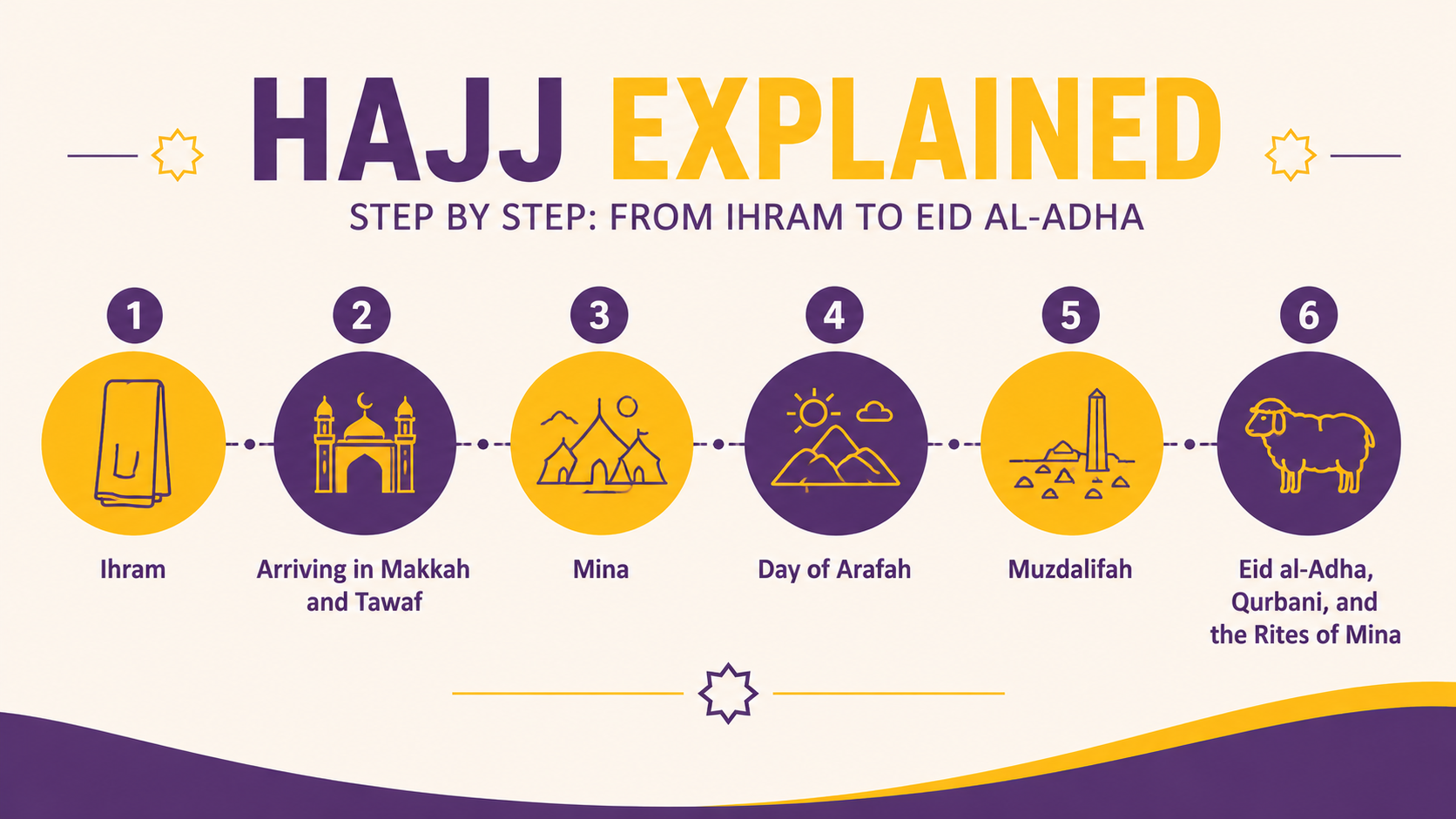
Every year, millions of Muslims travel to Makkah to complete the rites of Hajj in the order taught by the Prophet ﷺ. The journey moves from Ihram and Tawaf to Mina, Arafah, Muzdalifah, Eid al-Adha, and the final rites of Hajj.

Hajj is not simply a physical journey between places. Each stage carries acts of worship and lessons connected to obedience, humility, and returning to Allah.


1. What Is Hajj and Who Must Perform It

Hajj is the pilgrimage to Makkah and is obligatory once in a lifetime for every Muslim who is able to perform it. Ability includes physical, financial, and practical capability.

Allah says:

"In it are clear signs and the standing-place of Abraham. Whoever enters it should be safe. Pilgrimage to this House is an obligation by Allah upon whoever is able among the people. And whoever disbelieves, then surely Allah is not in need of ˹any of His˺ creation."
(Qur'an 3:97)

This verse establishes Hajj as a religious obligation for those who are capable of undertaking the journey.

Because of this, Hajj is approached with preparation, learning, and intention. It is not treated as tourism or travel alone, but as one of the greatest acts of worship in Islam.


2. Entering the State of Ihram

The journey of Hajj formally begins with Ihram. Ihram is both a sacred state and a set of restrictions connected to the pilgrimage.

Before reaching the Miqat, pilgrims prepare themselves by making ghusl and entering into Ihram with the intention of Hajj. Men wear two unstitched white cloths, while women wear normal modest clothing that fulfils the requirements of hijab and Ihram.

Pilgrims then begin reciting the Talbiyah:

لَبَّيْكَ اللَّهُمَّ لَبَّيْكَ، لَبَّيْكَ لَا شَرِيكَ لَكَ لَبَّيْكَ، إِنَّ الْحَمْدَ وَالنِّعْمَةَ لَكَ وَالْمُلْكَ، لَا شَرِيكَ لَكَ

Labbayka Allahumma labbayk, labbayka la sharika laka labbayk. Inna al-hamda wan-ni'mata laka wal-mulk, la sharika lak.

Here I am, O Allah, here I am. Here I am, You have no partner, here I am. Surely all praise, blessings, and dominion belong to You. You have no partner.

Ihram places the pilgrim into a state centred around worship, humility, and obedience. Certain normal actions become restricted, helping the pilgrim focus fully on the sacred journey ahead.


3. Arriving in Makkah and Performing Tawaf

After arriving in Makkah, pilgrims perform Tawaf around the Ka'bah and Sa'i between Safa and Marwah. Tawaf consists of circling the Ka'bah seven times in worship, while Sa'i commemorates the struggle and trust of Hajar عليها السلام as she searched for water.

The order of these rites is established in the Sunnah. It is narrated:

"The Prophet ﷺ arrived at Mecca and performed Tawaf of the Ka'bah and Sa'i between Safa and Marwah…"
(Sahih al-Bukhari 1625)

These acts begin the Hajj journey spiritually and physically. The pilgrim enters Makkah not simply as a visitor, but as a worshipper moving through rites connected to remembrance and submission to Allah.


4. Mina: The Beginning of the Main Days of Hajj

On the 8th of Dhul Hijjah, pilgrims travel to Mina. This marks the beginning of the main days of Hajj.

In Mina, pilgrims spend the day and night in prayer, remembrance, and preparation before the Day of Arafah. Compared to later stages of Hajj, Mina is calmer and gives pilgrims time to focus themselves spiritually before the central rites begin.

This stage also reflects an important part of Hajj: patience, simplicity, and collective worship among millions of Muslims gathered together.


5. The Day of Arafah: The Heart of Hajj

On the 9th of Dhul Hijjah, pilgrims travel from Mina to Arafah. The standing at Arafah is the central pillar of Hajj. Pilgrims spend the day making du'a, repenting, remembering Allah, and turning back to Him sincerely.

The Prophet ﷺ said:

"The Hajj is 'Arafat, the Hajj is 'Arafat, the Hajj is 'Arafat…"
(Jami` at-Tirmidhi 2975)

This hadith shows the importance of Arafah within the pilgrimage. Missing the standing at Arafah means the Hajj itself is not complete.

For pilgrims, this day becomes a time of humility, reflection, and intense worship. It is often regarded as the emotional and spiritual peak of the pilgrimage.


6. Muzdalifah: Night of Remembrance and Preparation

After sunset on the Day of Arafah, pilgrims travel to Muzdalifah. There they combine prayers, spend the night, remember Allah, and prepare for the next stage of Hajj.

Pilgrims also collect pebbles in Muzdalifah for the stoning of the Jamarat during the Days of Mina.

This stage is quieter and more reflective after the intensity of Arafah. It prepares pilgrims for Eid al-Adha and the remaining rites of Hajj.


7. Eid al-Adha, Qurbani, and the Rites of Mina

On the 10th of Dhul Hijjah, the Day of Eid al-Adha, pilgrims return to Mina and begin several major rites.

First, they stone Jamarat al-Aqaba with seven pebbles while saying "Allahu Akbar" with each throw. This act symbolises rejecting temptation and disobedience.

After this comes Qurbani. The Prophet ﷺ said:

"The first thing we will do on this day of ours, is to offer the ('Id) prayer and then return to slaughter the sacrifice."
(Sahih al-Bukhari 5545)

This establishes the order of the Eid rites connected to sacrifice.

Pilgrims then shave or trim their hair. Men usually shave or shorten the hair completely, while women trim a small portion. This marks a major stage of exiting Ihram restrictions.

Pilgrims also perform Tawaf al-Ifadah in Makkah before returning to Mina for the Days of Tashreeq. During these days, pilgrims continue stoning the three Jamarat.

The Days of Mina are also connected to remembrance of Allah and completion of the remaining rites of Hajj.


8. The Farewell Tawaf and Completing Hajj

Before leaving Makkah, pilgrims perform the Farewell Tawaf, known as Tawaf al-Wada'. This is the final Tawaf before departing from the city. It is narrated:

"The people were ordered to perform the Tawaf of the Ka'bah (Tawaf al-Wada') as the last thing before leaving (Makkah), except the menstruating women who were excused."
(Sahih al-Bukhari 1755)

This final act closes the pilgrimage with worship and remembrance before the pilgrim returns home.


9. Lessons and Spiritual Meaning of Hajj

Every stage of Hajj carries lessons beyond the outward actions themselves:

  • Ihram teaches humility and equality
  • Tawaf centres the believer around worship
  • Sa'i teaches trust and effort
  • Mina teaches patience and preparation
  • Arafah teaches repentance and surrender
  • Muzdalifah teaches remembrance and simplicity
  • The stoning of the Jamarat symbolises rejecting evil and temptation
  • Qurbani reflects sacrifice and obedience to Allah

Hajj also brings together Muslims from every background, language, and country in one shared act of worship. It reminds believers of unity, accountability, humility, and returning to Allah.


10. Final Takeaway

Hajj is a journey from intention to sacrifice, from Ihram to Eid al-Adha, and from outward movement to inward change.

Understanding the steps of Hajj helps clarify the pilgrimage, but the deeper purpose is worship, sincerity, obedience, and remembrance of Allah.

For many pilgrims, the goal is not only to complete the rites correctly, but to return home changed by the journey itself.
How to Prepare for Eid al-Adha: Sunnahs, Worship, and Key Reminders

How to Prepare for Eid al-Adha: Sunnahs, Worship, and Key Reminders

Quick Donation
Donate Now

Eid al-Adha is not only a day of celebration. It is a day of worship, sacrifice, gratitude, and remembrance of Allah. Preparation for Eid begins before the day itself, especially during the blessed days of Dhul Hijjah.

Allah says regarding Qurbani:

"Neither their meat nor blood reaches Allah. Rather, it is your piety that reaches Him. This is how He has subjected them to you so that you may proclaim the greatness of Allah for what He has guided you to, and give good news to the good-doers."
(Qur'an 22:37)

This verse reminds Muslims that the purpose of Eid al-Adha is not only the outward act of sacrifice. It is sincerity, remembrance, obedience, and gratitude to Allah.

Preparing properly for Eid helps connect the day back to worship rather than routine celebration alone.


1. Prepare Spiritually During Dhul Hijjah and Eid

Preparation for Eid begins during the first ten days of Dhul Hijjah. These are days of increased worship, remembrance, du'a, charity, and reflection.

One of the most important acts during this period for those not performing Hajj is fasting on the Day of Arafah. The Prophet ﷺ was asked about fasting on the Day of Arafah and said:

"It expiates the sins of the preceding year and the coming year."
(Sahih Muslim 1162b)

These days are also strongly connected to dhikr and Takbir. Many Muslims increase in remembrance of Allah throughout Dhul Hijjah, especially from the Day of Arafah through the Days of Tashreeq.

For those intending to offer Qurbani, there is also guidance connected to hair and nails during this period. The Prophet ﷺ said:

"When the first ten days of Dhul-Hijjah begin, and one of you intends to offer a sacrifice, let him not remove anything from his hair or nails until he has offered his sacrifice."
(Sahih Muslim 1977g)

Scholars differ slightly on whether this is obligatory or strongly recommended, but many Muslims follow this guidance as part of preparing spiritually for Qurbani and Eid al-Adha.


2. Arrange Your Qurbani Early

One of the most important practical preparations for Eid al-Adha is arranging Qurbani before Eid.

UK Islamic charity guidance commonly explains that Qurbani should be organised early so it can be carried out properly after the Eid prayer and distributed to those in need.

The Prophet ﷺ said:

"The first thing we will do on this day of ours, is to offer the ('Id) prayer and then return to slaughter the sacrifice."
(Sahih al-Bukhari 5545)

This hadith establishes the correct order of Eid al-Adha:

  • Eid prayer first
  • Qurbani after

A sacrifice performed before the Eid prayer does not count as the Eid sacrifice itself according to the Sunnah.

Preparing early also helps ensure that the sacrifice reaches vulnerable families properly. Many UK Islamic organisations emphasise that Qurbani is not only about the sacrifice itself, but also about feeding and supporting those in need.


3. Prepare for Eid Morning

Eid morning preparation should be calm and intentional. Islamic guidance commonly recommends:

  • Making ghusl
  • Wearing clean or best clothes
  • Applying fragrance
  • Preparing for the Eid prayer properly

Many of these practices come through the guidance of scholars and the practice of the companions regarding Eid etiquette and communal worship.

The purpose is not appearance alone. Eid begins with cleanliness, preparation, and approaching the prayer in a respectful and grateful manner.

It is also beneficial to prepare the family early and avoid turning the morning into stress and rushing before the prayer.


4. Attend the Eid Prayer

The Eid prayer is one of the central acts of Eid al-Adha. It gathers the Muslim community together in worship before the day continues with sacrifice, visits, and celebration.

The Prophet ﷺ placed strong emphasis on attending the Eid gathering. It is narrated:

"The Messenger of Allah ﷺ commanded us to bring out on 'Id-ul-Fitr and 'Id-ul-Adha young women, menstruating women and screened away ladies. The menstruating women were to keep away from the prayer, witnessing the goodness and the supplication of the Muslims."
(Sahih Muslim 890c)

This shows the importance of the Eid gathering itself. Even those not praying were encouraged to attend and witness the gathering of the Muslims.

The khutbah after the prayer is also part of the Eid gathering and should not be rushed away from unnecessarily.

Another often-forgotten Sunnah is returning home through a different route where possible. It is narrated:

"On the Day of 'Id the Prophet ﷺ used to return (after offering the 'Id prayer) through a way different from that by which he went."
(Sahih al-Bukhari 986)

Even small Sunnahs like this help preserve the spirit and practice of Eid.


5. Share, Give, and Remember Those in Need

Eid al-Adha is closely connected to feeding others and remembering those facing hardship. Qurbani is not meant to remain a private act. Its benefit should reach others.

The Prophet ﷺ said regarding the sacrifice meat:

"…eat, preserve and give in charity."
(Sahih Muslim)

This reflects the communal nature of Eid al-Adha.

Many UK Islamic charities explain that Qurbani distribution supports:

  • Vulnerable families
  • Widows
  • Orphans
  • Refugees
  • People experiencing food insecurity and poverty

For many families around the world, Eid may be the only time in the year they are able to eat meat.

Preparing for Eid therefore also means preparing to give, share, and include others in the blessings of the day.


6. Common Mistakes to Avoid

A few common mistakes can weaken the purpose and preparation of Eid:

  • Leaving Qurbani arrangements too late
  • Misunderstanding Qurbani timing
  • Neglecting Takbir and remembrance
  • Missing the Eid prayer without reason
  • Leaving before the khutbah
  • Treating Eid only as a social celebration
  • Forgetting vulnerable people and those in need

Most of these mistakes are avoidable with early preparation and understanding the purpose of Eid al-Adha properly.


7. Final Takeaway

Preparing for Eid al-Adha means preparing both outwardly and inwardly.

It includes worship during Dhul Hijjah, arranging Qurbani correctly, attending the Eid prayer, remembering Allah, and caring for others.

The best preparation is not only about organising the day itself. It is about entering Eid with gratitude, sincerity, obedience, and concern for those who are struggling.

Eid al-Adha Explained: Prayer, Qurbani and Remembering Those in Need

Eid al-Adha Explained: Prayer, Qurbani and Remembering Those in Need

Quick Donation
Donate Now

Eid al-Adha is more than a day of celebration. It is a day of prayer, sacrifice, gratitude, and remembrance of Allah. It connects worship with care for others and reminds Muslims of obedience, sincerity, and generosity.

Allah says regarding Qurbani:

"Neither their meat nor blood reaches Allah. Rather, it is your piety that reaches Him. This is how He has subjected them to you so that you may proclaim the greatness of Allah for what He has guided you to, and give good news to the good-doers."
(Qur'an 22:37)

This verse captures the spirit of Eid al-Adha. The purpose is not the outward act alone, but the sincerity, gratitude, and remembrance behind it.

UK Islamic charity guidance often highlights this connection between worship and community care. Eid al-Adha is not only about sacrifice itself. It is also about ensuring others are included in the blessings of the day.


1. Eid al-Adha and the Legacy of Sacrifice

Eid al-Adha is closely connected to the legacy of Prophet Ibrahim عليه السلام and his willingness to submit completely to the command of Allah. Qurbani continues as a remembrance of that obedience and sacrifice.

The Prophet ﷺ said:

"The first thing we will do on this day of ours is to offer the ('Id) prayer and then return to slaughter the sacrifice. Whoever does so, he acted according to our Sunnah…"
(Sahih al-Bukhari 5545)

This hadith connects the Eid prayer directly with Qurbani and shows that sacrifice is part of the worship of Eid itself.

UK Islamic charities commonly describe Qurbani as an act of worship, obedience, and gratitude. The sacrifice is not simply a ritual tradition. It is meant to revive the lessons of submission, sincerity, and willingness to give for the sake of Allah.


2. Gratitude During Eid

Eid is a time to recognise blessings and thank Allah for them. Families gather, food is shared, and communities come together in worship and celebration.

But gratitude in Islam is not only spoken. It is shown through worship, remembrance, generosity, and care for others.

This is why the Qur'an connects sacrifice with proclaiming the greatness of Allah and recognising His guidance. Eid becomes meaningful when gratitude moves beyond personal enjoyment and turns into compassion and generosity toward others.

Many Islamic organisations working in Qurbani distribution also emphasise this point. For many vulnerable families around the world, Eid meat may only come once a year. Remembering this changes how a person approaches the day and the blessings they have been given.


3. Remembering Those in Need During Eid

One of the clearest messages of Eid al-Adha is remembering those facing hardship. Qurbani is not meant to remain a private act. Its benefit should reach others.

The Prophet ﷺ said regarding the sacrifice meat:

"…eat, preserve and give in charity."
(Sahih Muslim)

This reflects an important principle of Eid al-Adha: sharing.

UK Islamic charity programmes often explain that Qurbani reaches:

  • Vulnerable families
  • Refugees
  • Widows
  • Orphans
  • People facing food insecurity and poverty

For many people around the world, Qurbani may be the only time in the year they are able to eat meat.

This is why Eid should not become focused only on personal celebration. It is also a time for feeding others, giving charity, maintaining family ties, and ensuring vulnerable people are not forgotten.


4. A Time for Unity, Mercy, and Du'a

Eid brings Muslims together through prayer, remembrance, giving, and shared celebration. It is also a time to remember those facing hardship across the world.

Families affected by war, poverty, displacement, hunger, and loss are often unable to experience Eid in the same way others do. This is why many Muslims spend Eid making du'a, giving charity, and supporting relief efforts for vulnerable communities.

Mercy and compassion are central to the spirit of Eid. The day should soften the heart, strengthen family and community ties, and remind people of their responsibility toward others.


5. Final Eid Message

Eid al-Adha is a day of gratitude, sacrifice, and remembrance. It reminds Muslims to thank Allah, follow the example of Prophet Ibrahim عليه السلام, and remember those who are struggling.

The true message of Eid is not only found in what we receive, but also in what we give.

When prayer, Qurbani, charity, and compassion come together, Eid becomes more than a celebration. It becomes a means of bringing relief, dignity, and hope to others.

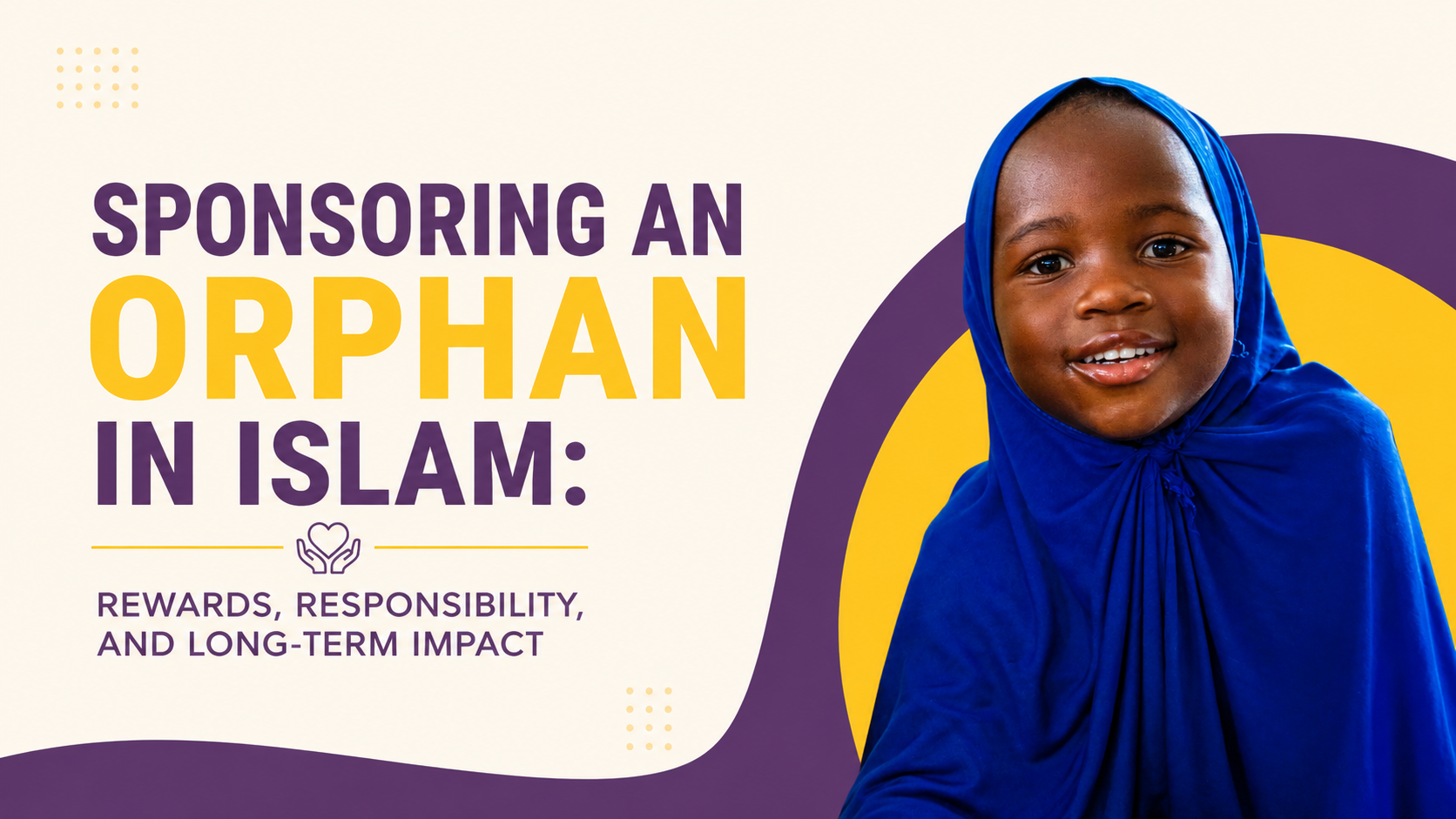
Sponsoring an Orphan in Islam: Rewards, Responsibility, and Long-Term Impact

Sponsoring an Orphan in Islam: Rewards, Responsibility, and Long-Term Impact

Quick Donation
Donate Now

Caring for orphans holds a special place in Islam. It is not presented as a small act of kindness, but as a major responsibility connected to mercy, protection, and social care.

Allah says:

"They ask you ˹O Prophet˺ what they should spend. Say, 'Whatever you spend of good is for parents and relatives and orphans and the needy and the traveler. And whatever you do of good, indeed Allah is Knowing of it.'"
(Qur'an 2:215)

This verse directly places orphans among those who deserve support and care.

Modern orphan sponsorship programmes often focus on long-term support for children affected by poverty, war, displacement, and loss of parental care. UK Islamic charities commonly describe this support as including food, shelter, healthcare, education, and wider wellbeing support.

In Islam, however, orphan care is not only humanitarian. It is also deeply spiritual and connected to accountability, mercy, and reward.


1. What Does Sponsoring an Orphan Mean in Islam

Sponsoring an orphan means more than sending money. It means helping provide stability, care, dignity, and protection for a child who has lost parental support.

UK Islamic charity guidance often describes orphan sponsorship as support for essentials such as:

  • Food
  • Shelter
  • Healthcare
  • Education
  • Clothing and welfare

Many programmes also include wider family and community support to help protect children from exploitation, hunger, and instability.

One important point in Islamic law is that sponsorship is not the same as adoption in the modern legal sense. Islam strongly encourages caring for orphans, but it also preserves the child's identity and lineage.

Allah says:

"Nor does He regard your adopted children as your real children. These are only your baseless assertions. But Allah declares the truth, and He ˹alone˺ guides to the ˹Right˺ Way."
(Qur'an 33:4)

This means caring for an orphan does not erase the child's family identity or lineage. Sponsorship in Islam is built around care, responsibility, and protection while preserving the child's rights.


2. The Importance and Reward of Caring for Orphans in Islam

The reward for caring for an orphan is strongly emphasised in the Sunnah.

The Prophet ﷺ said:

"I and the person who looks after an orphan and provides for him, will be in Paradise like this," putting his index and middle fingers together.
(Sahih al-Bukhari 6005)

This is one of the clearest hadith regarding orphan care. The image of closeness to the Prophet ﷺ in Paradise shows how greatly this act is valued in Islam.

The hadith also reflects something important: caring for an orphan is not treated as optional social generosity alone. It is an act connected to mercy, responsibility, and worship.

This is why orphan support appears repeatedly in Islamic charitable work and community care. The emphasis is not only on helping financially, but on protecting vulnerable children and helping restore dignity and stability to their lives.


3. Responsibility Beyond Financial Support

A strong orphan sponsorship programme should not reduce the child to a monthly payment. The responsibility is wider than that.

Islam places strong emphasis on protecting the rights and dignity of orphans. Allah says:

"Give orphans their wealth and do not substitute the defective [of your own] for the good [of theirs]. And do not consume their properties into your own. Indeed, that is ever a great sin."
(Qur'an 4:2)

This verse shows that orphan care includes justice, protection, and safeguarding rights.

Because of this, proper orphan support extends beyond food or money alone. UK Islamic charity programmes commonly include:

  • Education
  • Healthcare
  • Emotional and psychological support
  • Safe living conditions
  • Protection from exploitation and child labour
  • Family livelihood support

An orphan does not only need survival. A child also needs stability, belonging, care, and a path toward adulthood.


4. The Long-Term Impact of Supporting an Orphan

Long-term support can completely change the direction of a child's life.

Consistent sponsorship can help provide:

  • Education
  • Food security
  • Healthcare
  • Emotional support
  • Protection from harmful circumstances

Many UK Islamic charities explain that orphan sponsorship is designed not only to meet immediate needs, but to help children move out of long-term poverty and instability.

The impact often extends beyond one child. Supporting education, family wellbeing, and protection can strengthen entire households and communities over time.

This is why orphan sponsorship is often treated as one of the most impactful forms of ongoing charity.


5. Common Misunderstandings About Orphan Sponsorship

One misunderstanding is that orphan sponsorship only means paying for food. In reality, proper care often includes education, healthcare, emotional support, and protection.

Another misunderstanding is that short-term help is enough. Emergency support is important, but long-term care gives a child more stability and opportunity for the future.

A third misunderstanding is confusing sponsorship with adoption. Islam strongly encourages caring for orphans while preserving the child's lineage and identity. Sponsorship is based on responsibility and care, not replacing family identity.


6. Final Takeaway

Supporting an orphan is one of the most emphasised forms of care in Islam.

It combines charity, mercy, responsibility, and long-term impact. It helps provide safety, dignity, and opportunity for vulnerable children while also carrying immense spiritual reward.

More importantly, it reflects a core Islamic principle: protecting those who have lost support and ensuring they are not left behind.

Takbeer of Dhul Hijjah: Meaning, Timing, and How to Recite It

Takbeer of Dhul Hijjah: Meaning, Timing, and How to Recite It

Quick Donation
Donate Now

Takbeer is one of the clearest signs of Dhul Hijjah and Eid al-Adha. It is a simple act of remembrance, but it carries deep meaning: openly declaring the greatness of Allah during some of the most blessed days of the year.

Allah says:

"That they may witness benefits for themselves and mention the name of Allah on known days over what He has provided for them of [sacrificial] animals. So eat of them and feed the miserable and poor."
(Qur'an 22:28)

The first ten days of Dhul Hijjah are among these "known days" mentioned by the scholars of tafsir and the early Muslims. This is why Takbeer becomes strongly connected to these days, especially around Eid al-Adha and the Days of Tashreeq.

Takbeer is not only an Eid tradition. It is an act of worship and remembrance that revives the atmosphere of Dhul Hijjah itself.


1. What Is the Takbeer of Dhul Hijjah and Why Is It Recited

Takbeer means saying "Allahu Akbar" meaning "Allah is the Greatest." During Dhul Hijjah, Muslims increase in Takbeer as a way of remembering Allah and openly glorifying Him during these blessed days.

The early Muslims connected this remembrance directly to the Qur'anic command to mention Allah during the appointed days of Dhul Hijjah.

Ibn 'Abbas رضي الله عنهما explained:

"Remember Allah during the well-known days; i.e., the first ten days of Dhul-Hijjah, and also the fixed number of appointed days; i.e. the days of Tashriq."
(Sahih al-Bukhari)

This shows that Takbeer is not restricted to Eid morning alone. It is connected to the wider season of Dhul Hijjah and the remembrance of Allah throughout these days.


2. Types of Takbeer and Their Timing

Scholars generally explain two forms of Takbeer during Dhul Hijjah: Takbeer al-Mutlaq and Takbeer al-Muqayyad.

2.1 Takbeer al-Mutlaq (General Takbeer)

This refers to Takbeer recited at any time during the day or night. It is not tied to the prayers.

UK Islamic guidance commonly explains that this begins from the start of Dhul Hijjah and continues until sunset on the 13th of Dhul Hijjah. A person may recite it:

  • At home
  • While travelling
  • In gatherings
  • In the mosque
  • Throughout daily life

This was part of openly reviving the remembrance of Allah during these blessed days.

2.2 Takbeer al-Muqayyad (Restricted Takbeer / Takbeer-e-Tashreeq)

This Takbeer is connected specifically to the obligatory prayers.

Many scholars and UK fiqh guidance state that it begins after Fajr on the 9th of Dhul Hijjah (the Day of Arafah) and continues after every fard prayer until Asr on the 13th of Dhul Hijjah. This means it is recited after 23 obligatory prayers in total during this period.

Unlike general Takbeer, this form is tied specifically to the prayer times.


3. How to Recite the Takbeer

A commonly recited wording of Takbeer is:

اللّٰهُ أَكْبَرُ، اللّٰهُ أَكْبَرُ، لَا إِلٰهَ إِلَّا اللّٰهُ، وَاللّٰهُ أَكْبَرُ، اللّٰهُ أَكْبَرُ، وَلِلّٰهِ الْحَمْدُ

Allahu Akbar, Allahu Akbar, la ilaha illa Allah, wallahu Akbar, Allahu Akbar, wa lillahil hamd.

Allah is the Greatest, Allah is the Greatest. There is no god except Allah. Allah is the Greatest, Allah is the Greatest, and all praise belongs to Allah.

This wording is authentically reported from companions including Umar ibn al-Khattab, Abdullah ibn Mas'ud, and Ali ibn Abi Talib رضي الله عنهم.

There are also slight variations reported from the companions, which shows that the wording has flexibility. The purpose is the remembrance and glorification of Allah during these days.


4. How the Companions Practiced the Takbeer

The companions did not treat Takbeer as something hidden or limited to the mosque. They practiced it openly. It is reported:

"Ibn 'Umar and Abu Hurairah used to go out to the market during the first ten days of Dhul-Hijjah saying Takbir, and the people would say Takbir after their Takbir."
(Sahih al-Bukhari)

This practice shows how visible Takbeer was during Dhul Hijjah. It was recited publicly and became part of the atmosphere of the community during these days.

The goal was not performance or loudness for its own sake, but reviving remembrance of Allah openly.


5. Final Takeaway

The Takbeer of Dhul Hijjah is one of the simplest Sunnahs to revive, yet one of the most powerful in meaning.

It keeps the days of Dhul Hijjah connected to remembrance, worship, and gratitude to Allah.

Whether through general Takbeer throughout the day or Takbeer after the prayers during the Days of Tashreeq, these words help preserve the spirit of Eid al-Adha and the blessed days surrounding it.

The Sunnahs of Eid al-Adha: Simple Practices Many People Forget

The Sunnahs of Eid al-Adha: Simple Practices Many People Forget

Quick Donation
Donate Now

Eid al-Adha is one of the two major Eids in Islam and is closely connected to Hajj, Qurbani, sacrifice, and remembrance of Allah. It is not only a day of celebration. It is also a day of worship, gratitude, and following the Sunnah of the Prophet ﷺ.

Allah says regarding sacrifice:

"Neither their meat nor blood reaches Allah. Rather, it is your piety that reaches Him. This is how He has subjected them to you so that you may proclaim the greatness of Allah for what He has guided you to, and give good news to the good-doers."
(Qur'an 22:37)

This verse captures the spirit of Eid al-Adha. The goal is not simply the outward act of sacrifice, but sincerity, remembrance, and obedience to Allah.

Alongside Qurbani, there are several Sunnahs connected to Eid day itself. Many are simple and easy to practice, yet often forgotten.


1. Preparing for Eid Before the Prayer

Preparation for Eid begins before leaving for the prayer. Scholars commonly mention making ghusl, wearing one's best clothes, using fragrance, and preparing oneself properly for the gathering of Eid.

Much of this comes through the practice of the companions and the general etiquette of attending major acts of worship. The purpose is to approach Eid with cleanliness, dignity, and gratitude.

This preparation reflects an important principle: Eid is not approached casually. It begins with intentional preparation before the prayer itself.


2. Delaying Eating Until After the Eid Prayer

One of the lesser-known Sunnahs of Eid al-Adha is delaying eating until after the Eid prayer.

The Prophet ﷺ differentiated between Eid al-Fitr and Eid al-Adha in this regard. It is narrated:

"The Prophet ﷺ would not leave on the Day of Fitr until he ate, and he would not eat on the day of Adha until he prayed."
(Jami` at-Tirmidhi 542)

This practice helps connect Eid al-Adha to Qurbani and sacrifice. Traditionally, many scholars mention that a person would eat from their sacrifice after the prayer where possible.

This Sunnah is recommended, not obligatory, but it is one of the small distinctions that gives Eid al-Adha its unique character.


3. Remembering Allah During Eid

Eid al-Adha is strongly connected to dhikr and Takbir. These days are not only days of celebration. They are also days of remembering Allah openly and frequently.

Allah says:

"…and mention the Name of Allah on appointed days over the beast of cattle that He has provided for them…"
(Qur'an 22:28)

The Takbir of Eid becomes especially visible during the days surrounding Eid al-Adha. Early Muslims would openly recite Takbir during the days of Dhul Hijjah and the Days of Tashreeq.

A commonly recited form of Takbir is:

اللّٰهُ أَكْبَرُ، اللّٰهُ أَكْبَرُ، لَا إِلٰهَ إِلَّا اللّٰهُ، وَاللّٰهُ أَكْبَرُ، اللّٰهُ أَكْبَرُ، وَلِلّٰهِ الْحَمْدُ

Allah is the Greatest, Allah is the Greatest, there is no god except Allah. Allah is the Greatest, Allah is the Greatest, and all praise belongs to Allah.

The remembrance of Allah is one of the central themes of Eid. This is why Takbir remains one of the most important Sunnahs connected to these days.


4. Attending the Eid Prayer

The Eid prayer is one of the clearest public symbols of Eid. It brings the Muslim community together in worship before the day continues with sacrifice, visits, and celebration.

The Prophet ﷺ placed strong emphasis on attending the Eid gathering. It is narrated:

"The Messenger of Allah ﷺ commanded us to bring out on 'Id-ul-Fitr and 'Id-ul-Adha young women, menstruating women and screened away ladies. The menstruating women were to keep away from the prayer, witnessing the goodness and the supplication of the Muslims."
(Sahih Muslim 890c)

This hadith shows how important the Eid gathering was in the Sunnah. Even those not praying were encouraged to attend and witness the gathering of the Muslims.

The Eid prayer is not treated as a small optional event. It is one of the defining acts of the day itself.


5. Taking Different Routes to and From the Prayer

A simple Sunnah that is often forgotten is taking one route to the Eid prayer and returning by another. It is narrated:

"On the Day of 'Id the Prophet ﷺ used to return after offering the 'Id prayer through a way different from that by which he went."
(Sahih al-Bukhari 986)

Scholars mention several wisdoms behind this practice, including spreading the signs of Eid more widely and meeting more people from the community.

Even though it seems like a small detail, it reflects how carefully the Sunnah shaped the experience of Eid.


6. Listening to the Khutbah After the Prayer

The khutbah follows the Eid prayer and forms part of the wider Eid gathering. It is narrated:

"The Prophet ﷺ used to offer the prayer of 'Id-ul-Adha and 'Id-ul-Fitr and then deliver the Khutba after the prayer."
(Sahih al-Bukhari)

Many people leave immediately after the salah, but staying for the khutbah helps complete the gathering properly. The khutbah often reminds people about sacrifice, gratitude, remembrance, family ties, and the responsibilities owed to others.

Listening to it keeps the focus of Eid connected to worship and reflection, not only celebration.


7. Offering Qurbani After the Eid Prayer

One of the most important practical Sunnahs of Eid al-Adha is the correct timing of Qurbani.

The Prophet ﷺ said:

"On this day of ours, our first act of worship is the offering of prayer and then we will return and slaughter the sacrifice, and whoever does this concords with our Sunnah…"
(Sahih al-Bukhari)

He ﷺ also said:

"Anybody who slaughtered before the prayer should slaughter another animal in lieu of it…"
(Sahih al-Bukhari)

These narrations make the order very clear:

  • Eid prayer first
  • Qurbani after

This is one of the most commonly misunderstood practical issues around Eid al-Adha.


8. Commonly Forgotten Sunnahs and Mistakes

One of the biggest mistakes is treating Eid only as a social celebration while neglecting its acts of worship. Eid al-Adha is deeply connected to remembrance, sacrifice, prayer, and gratitude.

Other commonly forgotten Sunnahs include:

  • Neglecting Takbir
  • Arriving late for the Eid prayer
  • Leaving before the khutbah
  • Forgetting the Sunnah of taking a different route
  • Misunderstanding the timing of Qurbani

These may seem like small details, but together they preserve the spirit and structure of Eid in the way taught by the Prophet ﷺ.


9. Final Takeaway

The Sunnahs of Eid al-Adha are simple, but they shape the meaning of the day.

Preparing properly, attending the prayer, remembering Allah, listening to the khutbah, and offering Qurbani correctly all help connect Eid back to worship rather than routine celebration.

These are small practices, but reviving them helps preserve the spirit of Eid al-Adha as a day of obedience, gratitude, and remembrance.