



Sadaqah Beyond Money: Everyday Acts That Count
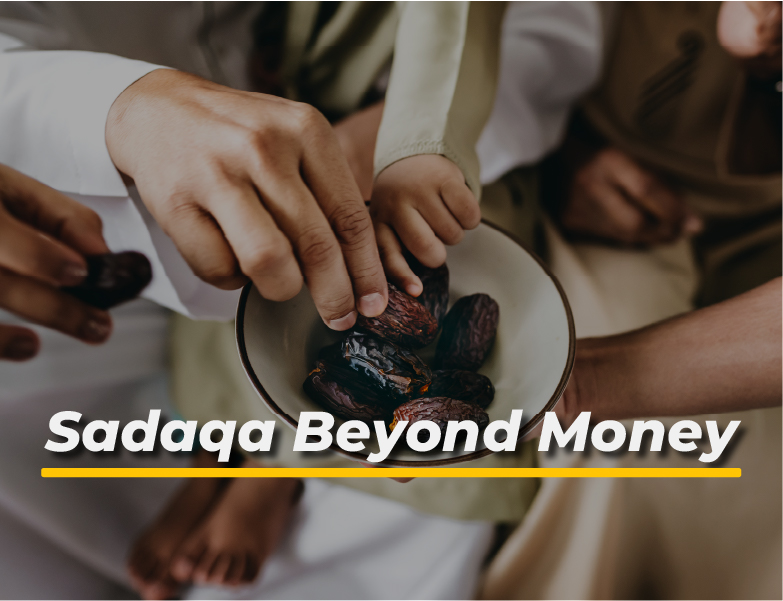
Sadaqah is often understood as giving money. In reality, it refers to any act of charity done sincerely for the sake of Allah, whether financial or non-financial.
It is voluntary, unlike Zakat, and it covers a wide range of actions that benefit others or reflect good character.
Allah sets the foundation for this in the Qur'an:
"So whoever does an atom's weight of good will see it."
(Qur'an 99:7)
This verse establishes a key principle: no act of goodness is insignificant. Every sincere action carries weight.
This is what makes Sadaqah unique. It is not limited to wealth. It is something that can be practiced daily, by anyone.
1. What Counts as Sadaqah in Islam
Sadaqah includes far more than financial giving. It includes actions, words, behaviour, and intention.
The Prophet ﷺ gave a complete explanation of this concept:
"Sadaqa is due on every joint of a person, every day the sun rises: to judge justly between two people is a Sadaqa; to help a man with his mount, lifting him onto it or hoisting up his belongings onto it, is a Sadaqa; a good word is a Sadaqa; every step you take towards the prayer is a Sadaqa; and removing a harmful thing from the road is a Sadaqa."
(Sahih Muslim 1009)
This hadith forms the foundation of the entire topic. It shows:
- Sadaqah is daily
- It applies to multiple types of actions
- It includes both physical and non-physical acts
It removes the idea that charity is limited to wealth.
2. Sadaqah Through Words
Words are one of the easiest and most consistent forms of Sadaqah.
Within the same hadith, the Prophet ﷺ said:
"…a good word is a Sadaqa…"
(Sahih Muslim 1009)
This includes:
- Speaking kindly
- Offering encouragement
- Giving sincere advice
- Calming someone in distress
A person may not always have money to give, but they always have the ability to speak well. That makes this form of Sadaqah constant.
3. Sadaqah Through Everyday Actions
Sadaqah is also found in everyday actions that benefit others.
The Prophet ﷺ said:
"Your smiling in the face of your brother is charity; your commanding what is good and forbidding what is evil is charity; your giving directions to a man lost in the land is charity for you; your seeing for a man with bad sight is a charity for you; your removal of a rock, a thorn or a bone from the road is charity for you; your pouring what remains from your bucket into the bucket of your brother is charity for you."
(Jami` at-Tirmidhi 1956)
This hadith expands the idea even further. It shows that Sadaqah includes:
- Simple acts like smiling
- Helping others practically
- Guiding and assisting
- Removing harm
- Sharing what you have
These are actions that happen in normal life. They do not require wealth, only awareness and intention.
4. Sadaqah Through Knowledge
Knowledge is one of the most impactful forms of Sadaqah.
The Prophet ﷺ said:
"When a man dies, his deeds come to an end except for three things: Sadaqah Jariyah (ongoing charity); a knowledge which is beneficial, or a righteous child who prays for him."
(Riyad as-Salihin 1383)
This hadith introduces an important concept: ongoing reward.
Sharing knowledge can continue to benefit others long after a person's life ends. Teaching, guiding, or spreading something useful becomes a form of Sadaqah that does not stop.
5. Small Acts That Carry Big Reward
A key theme in Sadaqah is that small actions matter.
The earlier hadith shows that even actions like:
- Taking a step
- Speaking a word
- Removing harm
are all counted as charity. This aligns directly with the Qur'anic principle:
"So whoever does an atom's weight of good will see it."
(Qur'an 99:7)
The focus is not on size. It is on sincerity and consistency. Small actions, done regularly, build significant reward over time.
6. Final Takeaway
Sadaqah is not limited to wealth. It is part of how a person lives.
A good word, a helping action, or sharing knowledge can all count as charity.
Once understood this way, Sadaqah becomes something that can be practiced every day, not just when money is given.




 Gift Aid
 Personal Details
 Secure Donation