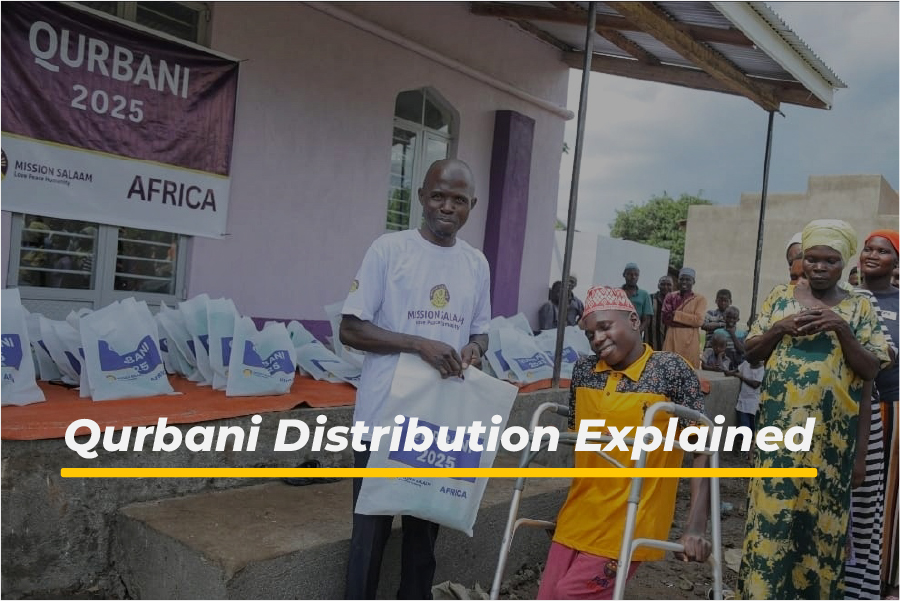
Qurbani is not only about the act of sacrifice. It is about what happens after.
The way the meat is shared gives meaning to the act. It connects the sacrifice to people, communities, and those who may rarely have access to meat. This is where the real impact of Qurbani becomes visible.
1. The Basic Principle of Sharing
The most common understanding of Qurbani distribution is built on three actions:
- Eating from it
- Keeping some of it
- Giving from it
This is based on the Prophetic guidance:
"Eat, store up and give in charity."
(Sahih Muslim)
"You may eat, store up and seek reward."
(Sunan Abi Dawud 2813)
From this, scholars later described a balanced way of sharing, often expressed as dividing the meat between oneself, others, and those in need.
The exact split is not fixed in hadith, but the principle of sharing across these groups is clearly established.
2. Is the "Three-Part Split" Required?
There is no direct hadith that requires the meat to be divided into exact thirds.
What the authentic narrations establish is flexibility. The focus is on ensuring that the meat is not kept entirely for oneself. It should be shared.
The commonly mentioned three-part division comes from scholarly explanation of how to apply the Prophetic guidance in a balanced way. It is a guideline, not a strict rule.
As long as the spirit of sharing is maintained, the exact proportions can vary.
3. Who Should Receive Qurbani Meat
Qurbani meat is meant to reach beyond the person offering it.
A companion described the practice during the time of the Prophet ﷺ:
"A man would sacrifice a sheep for himself and his household, and they would eat from it and feed others."
(Jami` at-Tirmidhi 1505, Hasan Sahih)
This shows two key points:
- The household benefits from the Qurbani
- Others are also included
Beyond this, Islamic guidance encourages extending charity to relatives:
"Giving charity to a poor person is charity, and (giving) to a relative is two things, charity and upholding the ties of kinship."
(Sunan an-Nasa'i 2582, Sahih)
This highlights why relatives are a strong category to include in distribution.
There is also guidance on neighbours:
"Give it to the neighbour whose door is closest to you."
(Sahih al-Bukhari 2595)
This supports including neighbours as part of sharing.
Together, these form a clear structure: Qurbani meat should reach your household, your circle, and others around you.
There is also an emphasis in Qurbani distribution is on those in need.
Abdullah b. Waqid reported:
"...They (the Muslims) said: Allah's Messenger, the people make waterskins with the (hides) of their sacrificed animals and they melt fat out of them. Thereupon he said. What then? They said: You forbade (us) to eat the flesh of sacrificial animals beyond three (days), whereupon he said: I forbade you for those (poor persons) who flocked (to the towns on this occasion for getting meat) but now when (this situation has improved) you may eat, preserve and give -in charity."
(Sahih al-Bukhari 5438)
This shows that feeding the poor is not a secondary outcome. It is central to the purpose of Qurbani.
This is why distribution focuses heavily on those who lack access to food. For many, Qurbani is not symbolic. It is a real source of nourishment.
5. Can You Give All of It Away?
The hadith allow eating from the Qurbani and also giving from it.
They do not set a rule that a person must keep a portion for themselves. The emphasis is on permission and encouragement, not obligation in this detail.
Because of this, scholars explain that it is allowed to give all of the meat away if there is a need or benefit in doing so.
This is often seen in organised Qurbani today, where the entire share is distributed to those who need it most.
6. Can Qurbani Be Distributed Overseas?
There is no direct hadith addressing modern distribution across countries.
This falls under practical application. The principle remains the same: the meat should reach those who need it.
In today's context, this often means distributing Qurbani in regions where food insecurity is higher. As long as the purpose of feeding and sharing is fulfilled, the location can vary.
7. Common Mistakes in Distribution
Some common mistakes go against the spirit of Qurbani:
- Treating it as personal consumption only
- Ignoring those in need
- Assuming fixed percentages must be followed
The Prophetic guidance clearly shows that Qurbani is not meant to remain private. It is meant to be shared.
Another key point is balance. Keeping everything or giving nothing misses the purpose. The goal is to ensure the benefit reaches others.
8. Why Distribution Matters
Qurbani distribution gives the act its wider impact.
It feeds people, supports families, and strengthens community ties. It ensures that the benefit of the sacrifice reaches beyond one person or one household.
The hadith emphasise this clearly. The act of sacrifice is directly linked to feeding others, especially those who need it most.
9. Final Takeaway
The Prophet ﷺ summarised the approach in simple terms:
"Eat, store and give in charity."
(Sahih Muslim)
This captures the essence of Qurbani distribution.
It is not only about the sacrifice. It is about sharing its benefit.








 Gift Aid
 Personal Details
 Secure Donation