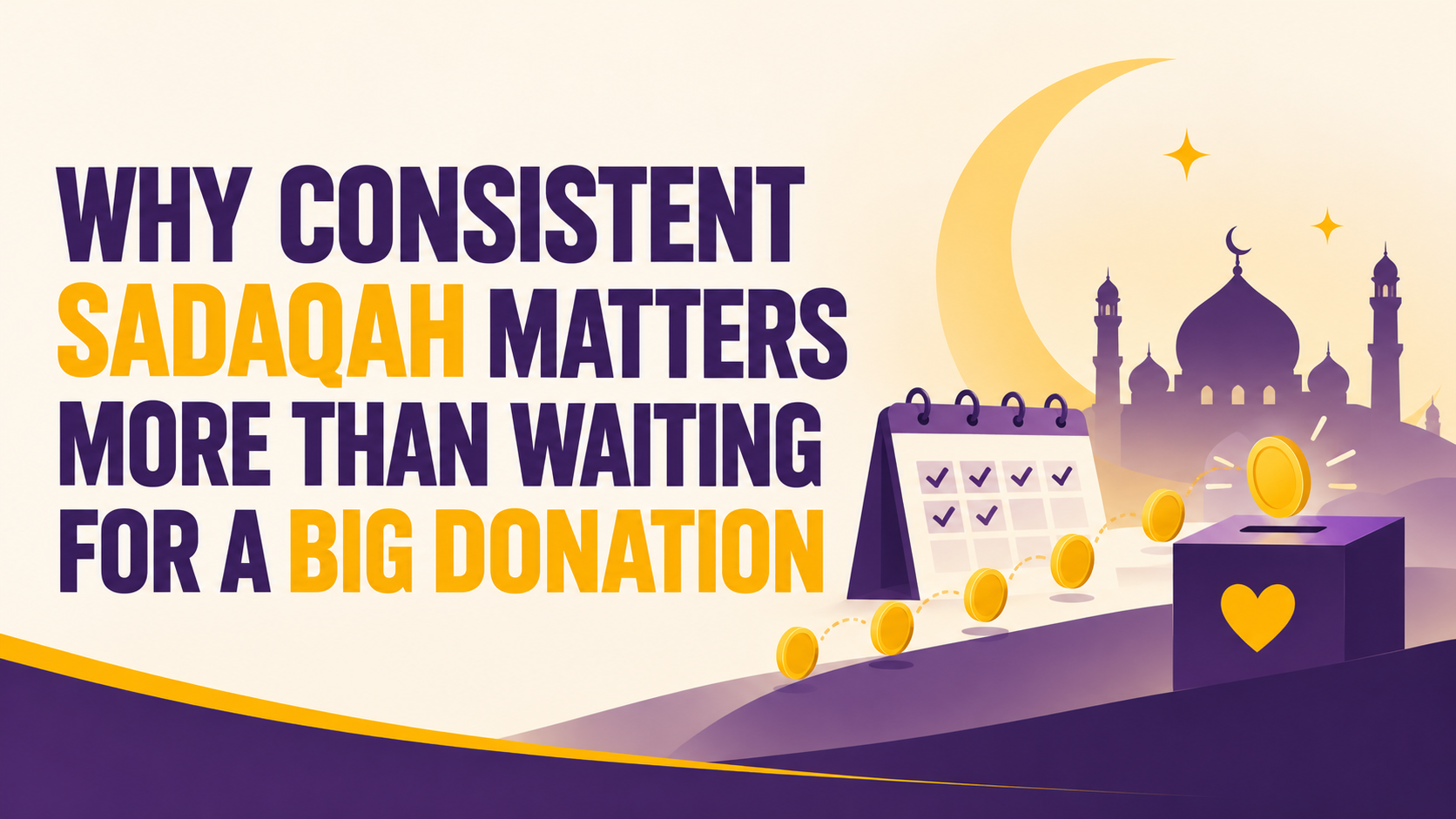
Many people intend to give when they earn more, clear a major expense or find the perfect cause. Months can pass while the imagined donation grows and the actual donation never begins.
Islam offers a more sustainable principle: do good within your ability and keep doing it. A small, sincere pattern of Sadaqah can become part of a Muslim’s life instead of an occasional response to emotion.
This does not make large donations unimportant. It means we should not use the hope of a large future gift to postpone the good we can do now.
1. What the Sunnah says about small, regular deeds
Before looking at consistency, it is worth asking why charity is delayed. Common reasons include waiting for a higher income, hoping to make one large gift, saving all voluntary giving for Ramadan, or assuming that future finances will feel safer.
Allah says:
“The Devil threatens you with the prospect of poverty and bids you to the shameful deed of stinginess, while Allah promises you forgiveness and great bounties from Him. And Allah is All-Bountiful, All-Knowing.”
(Qur’an 2:268)
This does not tell a person to ignore rent, debt or family duties. It warns against letting fear stop every affordable act of generosity.
The Prophet ﷺ also said:
“Protect yourself from the Fire even with half a date.”
(Sahih al-Bukhari 1417)
A small charity given now is better than a large plan that is delayed again and again.
The Prophet Muhammad ﷺ was asked which deeds Allah loves most. He replied: “The most regular constant deeds even though they may be few.” He also said not to take on deeds beyond one’s ability.
(Sahih al-Bukhari 6465)
The hadith applies to good deeds generally, including voluntary charity. Its emphasis is not on a token amount; it is on sincerity, continuity and a commitment the worshipper can sustain.
Allah also praises
“those who spend their wealth in charity day and night, secretly and openly.”
(Qur’an 2:274)
Giving becomes a repeated feature of their lives, not an act reserved for a perfect moment.
2. Consistent Giving Does Not Make Large Gifts Unimportant
The Prophetic principle corrects procrastination and unsustainable enthusiasm. It does not belittle generosity.
Balance also matters. When Ka’b ibn Malik wanted to give all his property in charity after Allah accepted his repentance, the Prophet ﷺ told him that keeping some was better.
(Sahih al-Bukhari 2757)
Regular Sadaqah should not cause missed rent, unpaid debt or neglect of dependants.
3. Why regular giving helps people and projects
From the recipient’s perspective, many needs repeat. Food is needed tomorrow as well as today. A child requires support through the school term. A water system needs monitoring and maintenance. A community service has predictable costs.
Recurring donations can give a charity a steadier base from which to plan. That benefit is practical rather than a guaranteed religious outcome: its value depends on the organisation, the project and whether the funds are managed well.
Regular giving can also help the donor. It reduces dependence on mood, makes the amount easier to budget and creates repeated moments of intention. The Prophet ﷺ said:
“Charity does not decrease wealth.”
(Sahih Muslim 2588)
This encourages trust in Allah, but it should not be marketed as a promise that the exact amount will return to your bank account.
4. Build a rhythm you can maintain
Write the amount into your normal budget rather than treating it as whatever remains at the end of the month. Linking it to payday can make the habit easier to remember. Some people split a monthly amount between one regular cause and a small emergency fund.
The amount should leave room for change. A manageable commitment is more likely to continue through school costs, travel and unexpected bills. The aim is steady worship, not financial pressure.
Choose a frequency linked to your circumstances: weekly, monthly or on each payday. Then choose an amount that remains comfortable after obligations.
- Start smaller than your maximum so the habit survives an expensive month.
- Select one cause, or divide the gift between immediate relief and lasting work.
- Automate the payment if that removes forgetfulness.
- Keep some giving private.
- Make a brief intention each time you see the payment leave your account.
For donors who prefer a structured option, Mission Salaam’s current “Mighty Fiver” appeal is built around modest recurring support across its charitable work. The value of any such arrangement lies in choosing it freely, checking the appeal and keeping the commitment within your means.
5. Review, pause and increase responsibly
Consistency does not mean a donation can never change. Review it every few months. If income grows, you may increase it. If circumstances become difficult, reduce or pause it without treating the change as failure. You can still give through time, service, a useful word or another non-financial form of Sadaqah.
Keep room for exceptional generosity too. A regular gift can be the foundation, while a larger donation responds to an emergency or a period of greater ability.
The goal is neither the smallest amount nor the most impressive amount. It is a truthful habit: something given for Allah, useful to others and sustainable enough to remain.